Introduction
In 2026, everyone has access to AI-generated “perfect” answers to interview questions. If you walk into an interview and recite a scripted response, you are effectively a human version of a chatbot—and you won’t get the job.
To win in today’s market, you need to master the Psychology of the Interview. This isn’t about what you say; it’s about how you frame your value and build a connection that an algorithm cannot replicate. Here are three unconventional hacks to turn an interview into a job offer.
1. The “Consultant Mindset” Hack
Most students approach an interview as an interrogation: the employer asks a question, and the student provides an answer. This creates a power imbalance that makes you look like a “junior” hire.
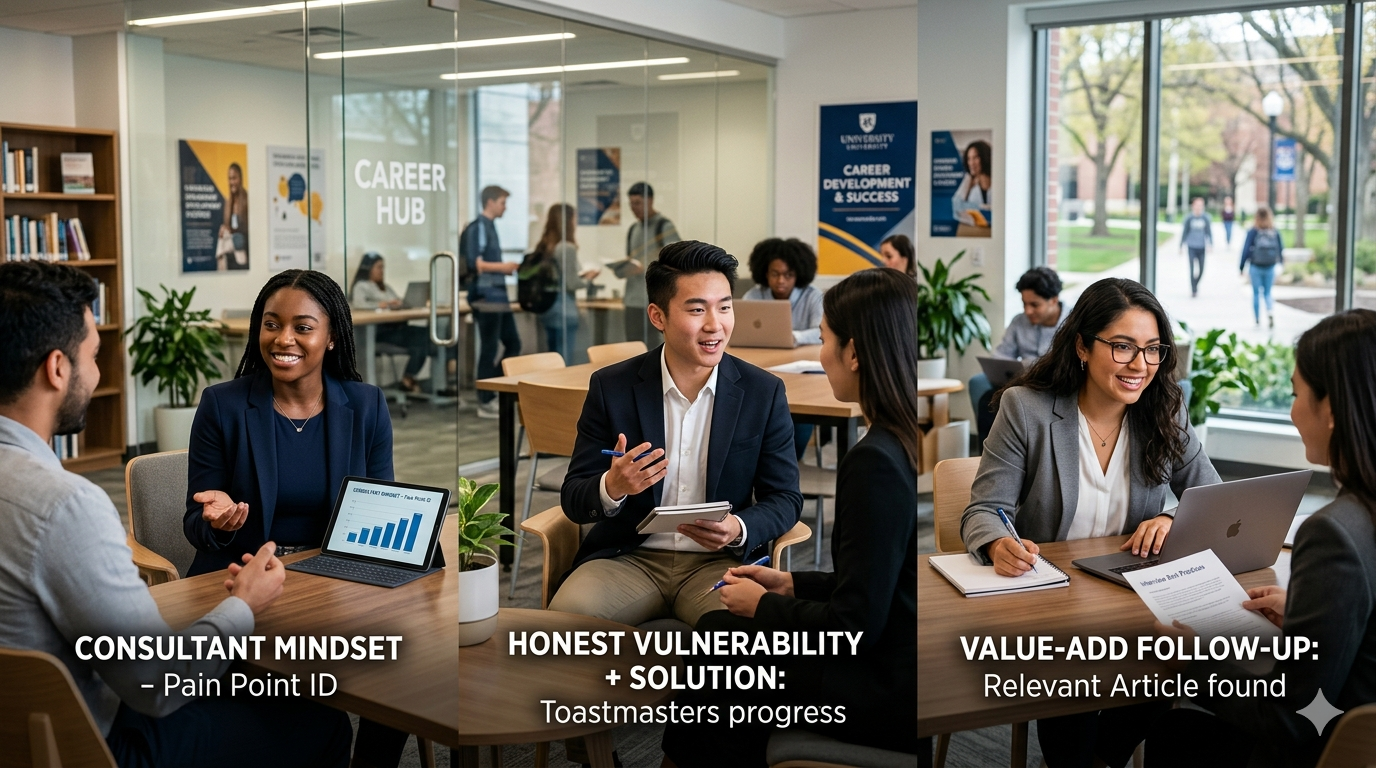
The Hack: Shift the dynamic from an interrogation to a consultation. Instead of just answering a question about your skills, ask a “discovery question” that shows you are thinking about their problems.
- How to do it: When they ask, “What are your strengths in Python?” answer briefly, then follow up with: “I’ve found Python particularly useful for automating data cleaning. Does your team currently struggle more with data collection or the actual analysis phase?”
- Why it works: You have now stopped being a “candidate” and started being a “partner.” You are identifying their pain points, which makes you instantly more valuable.
2. The “Reciprocal Vulnerability” Hack (The Best Way to Handle “Weakness”)
The most hated interview question is: “What is your greatest weakness?” Most students give a fake answer like, “I’m too much of a perfectionist.” Interviewers see right through this.
The Hack: Use Honest Vulnerability + Systematic Solution. Admit a real professional weakness, but immediately explain the “system” you built to fix it.
- How to do it: “Honestly, I used to struggle with public speaking and presenting my technical findings. To fix this, I joined a Toastmasters club last semester and started a ‘Friday Demo’ with my peers where I present my code every week. It’s still a work in progress, but my confidence has grown by 50%.”
- Why it works: It shows Self-Awareness and Proactivity. Employers aren’t looking for perfect people; they are looking for people who can identify their own gaps and fill them without being told.
3. The “Power of the Post-Interview Analysis” (The 24-Hour Rule)
Most candidates send a generic “Thank you for your time” email and then wait. In 2026, that is the bare minimum.
The Hack: Send a “Value-Add” Follow-Up. In your thank-you note, reference a specific problem or topic discussed during the interview and provide a small piece of additional value.
- How to do it: “Thank you for the conversation today. You mentioned the team is looking at migrating to [Specific Software]. I found this recent white paper on the exact migration challenges we discussed and thought it might be helpful for your team’s planning.”
- Why it works: It proves you were listening intently and that you are already working for them before you’ve even been hired. It makes it very easy for the manager to say, “This person gets it.”
Conclusion
An interview is not a test of your memory; it is a test of your professional maturity. By shifting into a consultant’s mindset, being honest about your growth, and providing value after the meeting, you separate yourself from the 99% of candidates who are just following a script.
Stop trying to be the “perfect” candidate. Start being the “helpful” expert.