The “Hidden Curriculum”: 3 Critical Skills for Career Success in the AI Era
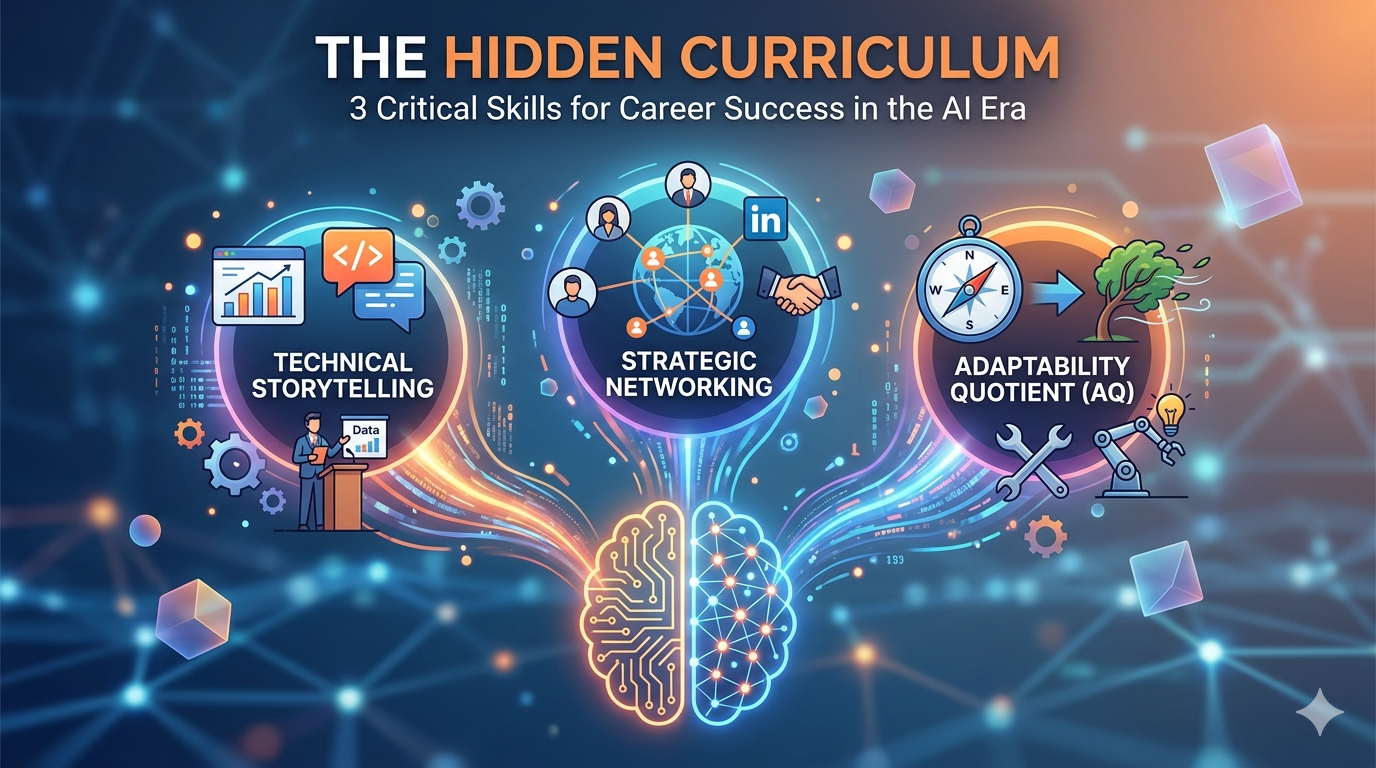
In the rapidly evolving landscape of 2026, mastering critical skills for career success has become the new global standard. The traditional roadmap—high GPAs and technical degrees—is no longer enough. Today’s employers are looking for the “Hidden Curriculum,” a set of high-level competencies that bridge the gap between academic theory and workplace impact. Whether you are an engineer or a business major, these critical skills for career success will ensure you remain indispensable in an increasingly automated world.
1. Technical Storytelling: A Critical Skill for Career Success
We live in an age of data saturation. While the ability to perform complex analysis is valuable, its impact is zero if stakeholders cannot understand the “why.” In 2026, Technical Storytelling is defined as the ability to translate specialized data into actionable business insights.
2. Strategic Networking and the “Hidden Job Market”
Most students view networking as a transactional chore, but true networking is an exercise in genuine curiosity. Statistics show that up to 80% of high-level positions are never publicly advertised; they are filled through referrals and existing professional networks. Building these connections is one of the most critical skills for career success you can develop.
The Action Plan: Reach out to three alumni in roles you admire. Ask for 15 minutes to discuss the “unspoken rules” of their industry. For more on professional networking standards, visit the Harvard Business Review →.
3. Developing Your Adaptability Quotient (AQ)
While IQ and EQ are important, 2026 has introduced a third metric: AQ (Adaptability Quotient). The half-life of a technical skill is now shorter than ever. This makes constant learning one of the top critical skills for career success in the modern era.
Becoming Tool-Agnostic
Instead of identifying as a “Python Developer,” identify as a “Problem Solver who utilizes Python.” This shift in mindset ensures that your value isn’t tied to a specific technology that could be replaced by AI. Dedicate one hour a week to “Uncomfortable Learning” to boost your critical skills for career success.
Conclusion: Beyond the Degree
Your university degree is your entry ticket, but your “Hidden Curriculum” is your career’s engine. By focusing on these critical skills for career success—Technical Storytelling, Strategic Networking, and AQ—you position yourself to lead the future of work. As you fill out your goals for 2026, ask yourself: What skills am I building that a machine cannot replicate?