How to Find Best Scopus Journals for Your Abstract
For postgraduate researchers, doctoral candidates, and early-career academics across institutions globally, publishing work in a reputable Scopus-indexed journal represents a vital step for professional growth, career promotion, and institutional accountability. However, the path from completing a manuscript abstract to receiving an acceptance letter is filled with potential missteps. One of the most frequent reasons for an immediate desk rejection—often occurring within 24 to 48 hours of submission—is mismatched journal scope. When an abstract is submitted to a publication that does not align with its thematic focus, methodology, or academic register, editors discard the submission without sending it out for formal peer review.
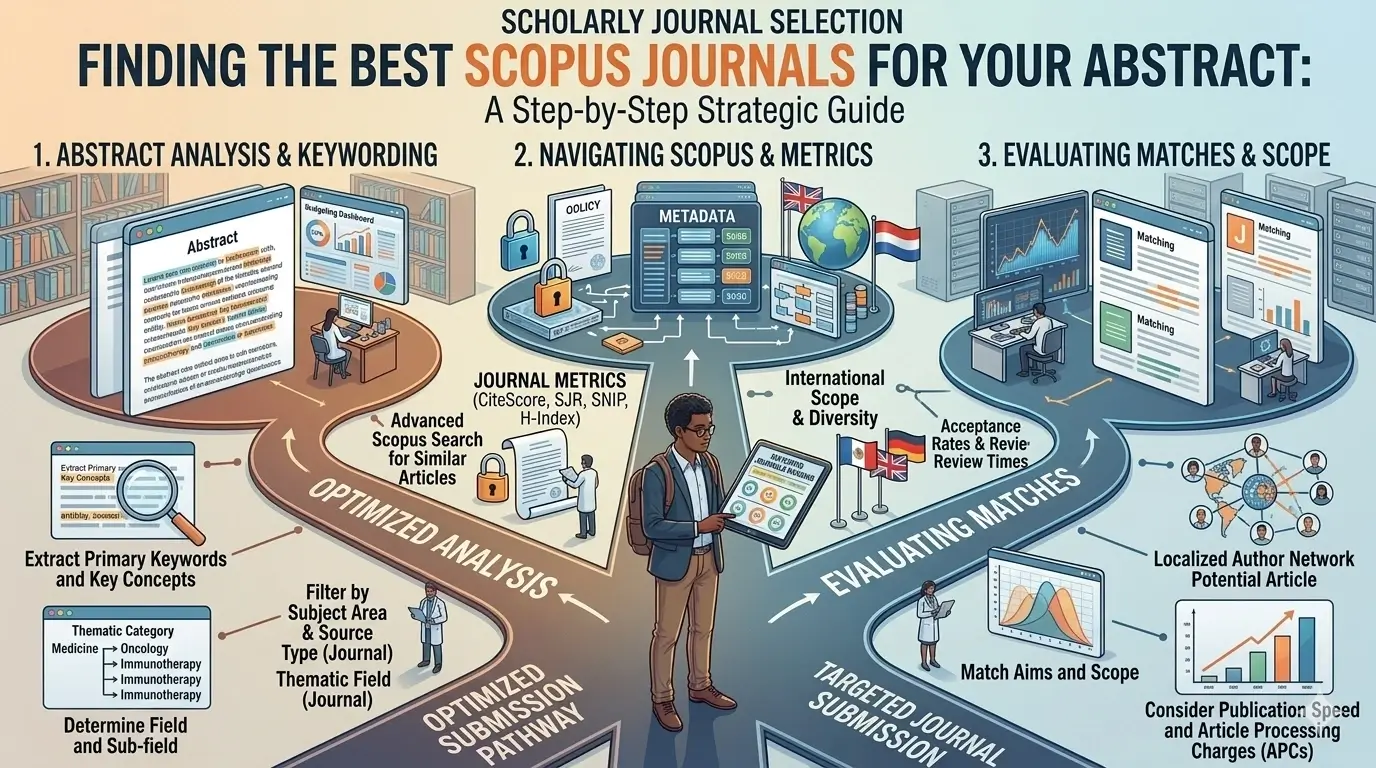
Finding the right Scopus journal for your abstract requires more than a casual Google search. It demands a systematic, data-driven approach that matches your core research keywords, study design, and contribution type with active, verified international publishing houses. This comprehensive guide details exact methodologies, publisher tools, metrics interpretation, and practical real-life scenarios to help you locate and target the most appropriate Scopus-indexed journals for your academic output.
1. Understanding the Scopus Indexing Landscape
Before diving into journal matching tools, it is crucial to understand what Scopus indexing signifies. Scopus, managed by Elsevier, is the world’s largest abstract and citation database of peer-reviewed literature. It encompasses scientific journals, books, and conference proceedings across physical sciences, health sciences, social sciences, and life sciences. Inclusion in Scopus guarantees that a journal meets rigorous international standards for peer review, regularity of publication, ethical guidelines, and citation tracking.
When selecting a target journal based on your abstract, you must ensure that the journal is currently active in the database. Predatory journals often claim “Scopus indexing” falsely or rely on discontinued index status. Therefore, your journal selection process must begin with verified publisher platforms and official indexing directories.
2. Utilizing Official Publisher Finder Platforms
Major international academic publishers have developed sophisticated, free online matching tools that analyze your title and abstract text, comparing them against thousands of indexed journal profiles using natural language processing algorithms. Below are the primary official platforms you should use:
Elsevier Journal Finder
Powered by Elsevier’s extensive database, this tool allows you to paste your paper title and abstract text directly into a search box. It cross-references your vocabulary with Elsevier’s portfolio of Scopus-indexed journals, returning a curated list of recommendations complete with match percentage scores, average publication speeds, acceptance rates, and Open Access options.
Access the official tool here: Elsevier Journal Finder.
Springer Journal Suggester
For researchers whose abstracts cover multidisciplinary sciences, technology, medicine, or humanities, Springer Nature offers a robust recommendation engine. By analyzing the thematic constructs within your abstract, it suggests relevant Springer and BioMed Central titles currently active in international citation indexes.
Access the official tool here: Springer Journal Suggester.
IEEE Publication Recommender
If your research abstract focuses on engineering, computer science, electrical systems, or telecommunications, the IEEE database engine is unmatched. It ranks indexed journals and conference proceedings based on technical keyword alignment.
Access the official tool here: IEEE Publication Recommender.
Real-Life Scenario: Saving Weeks of Manual Searching
An Indian doctoral researcher working on smart-grid solar energy integration had completed their abstract but struggled to decide between electrical power engineering journals and broader materials science periodicals. They pasted their 250-word abstract into the Elsevier Journal Finder and the IEEE Publication Recommender simultaneously. While Elsevier suggested multi-disciplinary energy journals, IEEE provided a precise match with an open-access power systems journal. This automated matching saved weeks of blind browsing and resulted in an acceptance letter within three months of submission.
3. Analyzing Your Reference List for Target Journals
One of the most reliable yet underutilized methods for finding a suitable Scopus journal is examining your own bibliography. When you drafted your abstract and background literature review, you cited 15 to 30 existing research papers. Those papers were published somewhere—and those publications represent peer communities actively interested in your specific topic.
Perform a frequency tally of your reference list:
- If three or more papers in your bibliography come from the same journal, that journal should sit at the top of your target submission list.
- Analyze whether those cited journals are currently active in Scopus by checking their ISSN numbers against the official source database.
- Examine the formatting style and argumentative tone of those cited articles to ensure your final manuscript aligns with their stylistic expectations.
4. Evaluating Journal Metrics: CiteScore, Quartiles, and Acceptance Speed
Finding a journal that matches your abstract’s theme is only half the battle; you must also evaluate the journal’s standing and metrics to ensure it aligns with your professional and institutional requirements.
Scopus Quartiles (Q1, Q2, Q3, Q4)
Scopus categorizes journals within subject categories into four quartiles based on their CiteScore metrics:
- Q1 Journals: Represent the top 25% of journals in the subject field. They boast high international visibility, rigorous peer review, and high prestige, but often experience lower acceptance rates and longer review cycles.
- Q2 and Q3 Journals: Represent the middle tiers. They offer balanced review timelines and strong academic recognition, making them ideal for early-career researchers building their portfolios.
- Q4 Journals: Represent the bottom 25% of the category. While still Scopus-indexed, they generally feature faster publication turnarounds but lower citation impact.
Strategic Advice: Always balance your career ambitions with your timeline. If your institution requires a publication before graduation or promotion review, targeting a fast-turnaround Q2 or Q3 journal is often safer than risking a 9-month review cycle in a hyper-competitive Q1 journal.
5. Avoiding Predatory and Discontinued Journals
The rise of open-access publishing has unfortunately introduced predatory journals that exploit early-career researchers by charging high publication fees without providing legitimate peer review. Furthermore, Scopus regularly re-evaluates journals and discontinues indexing titles that fail ethical or quality standards.
To protect your academic record:
- Always verify the journal’s title directly on the official Scopus Source List.
- Check if the journal’s website matches the official publisher domain or if it uses suspicious look-alike domains.
- Verify that editorial board members are recognized scholars in your specific field with verifiable institutional email addresses.
Conclusion
Finding the best Scopus journal for your abstract is a disciplined process that blends technical tool utilization with strategic metric evaluation. By leveraging official publisher finders like Elsevier, Springer, and IEEE, analyzing your bibliography, and verifying index status, you can position your research for rapid editorial acceptance and maximum global impact.