
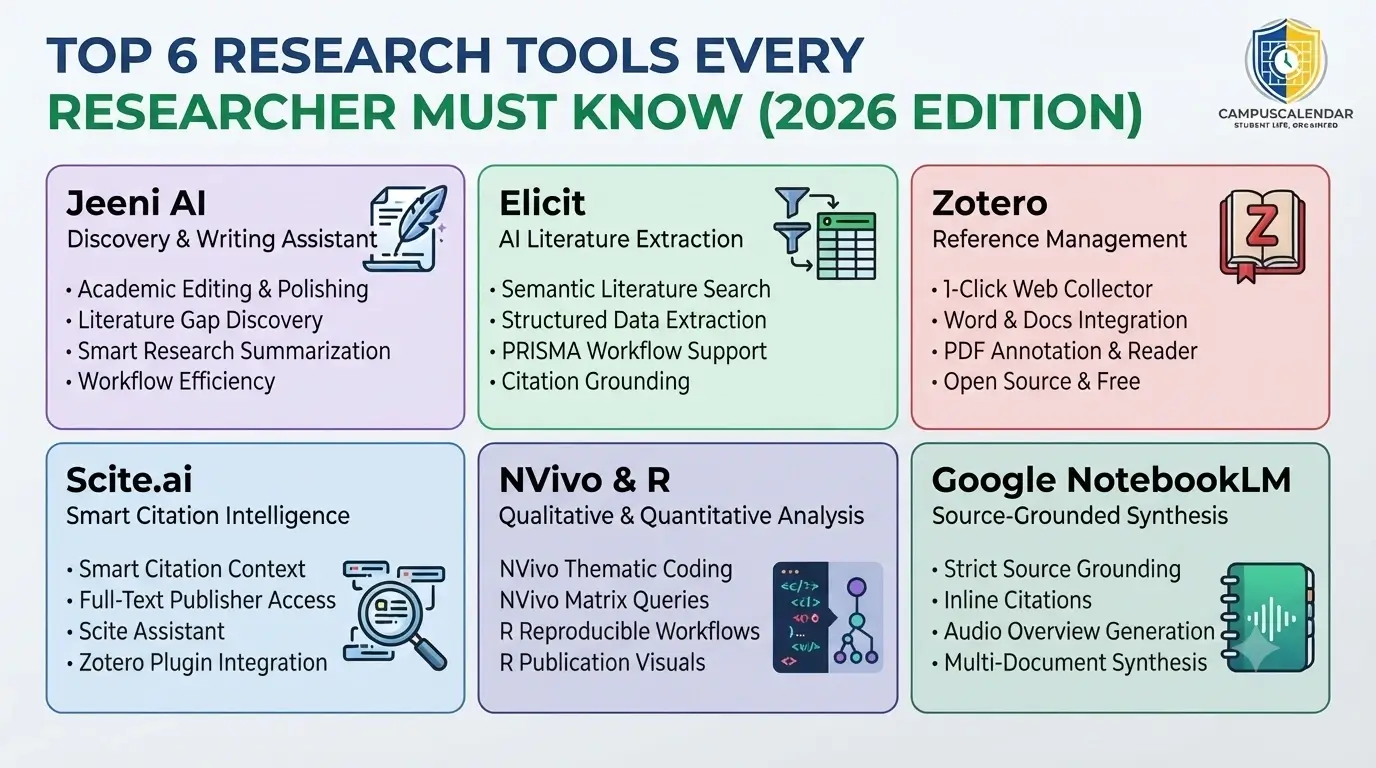
Top 6 Research Tools Every Researcher Must Know (2026 Edition)
The academic and scientific research ecosystem is growing faster than ever before. With millions of peer-reviewed papers published annually across thousands of journals, staying on top of literature reviews, maintaining precise citation networks, analyzing qualitative or quantitative datasets, and drafting publication-ready manuscripts can feel overwhelming. Managing hundreds of downloaded PDFs in disconnected desktop folders is no longer sustainable.
Modern research workflows rely heavily on specialized platforms that save time, improve literature search recall, automate citation formatting, and extract key insights transparently. Whether you are a PhD candidate working on your dissertation, a faculty member writing a grant proposal, or an R&D professional conducting market analysis, mastering the right software suite is essential.
Here is an in-depth breakdown of the Top 6 Essential Research Tools—including the innovative Jeeni AI platform—that every modern researcher should integrate into their daily workflow, along with their key capabilities, stand-out features, and best usage scenarios.
Key Takeaway: High efficiency in research does not come from using a single tool for everything. It comes from building an integrated pipeline: using dedicated discovery tools like Jeeni AI and Elicit for automated literature mapping, structured reference managers for citations, and specialized synthesis platforms for drafting.
Quick Comparison of Top Research Tools
| Tool Name | Primary Category | Best For | Key Distinction |
|---|---|---|---|
| Jeeni AI | Academic AI Research Assistant | Automated discovery & drafting workflows | End-to-end literature searching, editing, & paper structure |
| Elicit | AI Literature Extraction | Systematic reviews & data extraction | Direct sentence-level citation & table extraction |
| Zotero | Reference Management | Collecting, organizing & citing literature | Open-source, free, & robust plugin library |
| Scite.ai | Smart Citation Analysis | Contextual citation & evidence validation | Classifies citations as supporting or contrasting |
| NVivo / R | Data Analysis (Qual / Quant) | Statistical modeling & thematic analysis | Methodological rigor for deep datasets |
| Google NotebookLM | Source Synthesis & Notes | Grounded source Q&A & audio synthesis | Strictly grounded in your uploaded documents |
1. Jeeni AI — All-in-One Academic Research & Writing Assistant
Discovery & WritingJeeni AI has quickly emerged as an indispensable, comprehensive workspace tailored specifically for scholars, academicians, and independent researchers. While traditional tools often focus strictly on search or editing separately, Jeeni AI bridges the gap between raw paper discovery and drafting your final research paper.
By understanding academic structure and domain-specific terminology, Jeeni AI assists researchers with literature organization, paragraph refinement, paraphrasing, and identifying publication gaps in existing scientific studies. It acts as an intelligent peer editor, speeding up the journey from early ideation to a publication-ready manuscript.
2. Elicit — AI Research Assistant for Literature Extraction
Discovery & ExtractionElicit has established itself as one of the most reliable AI tools for researchers conducting systematic reviews, rapid literature screening, and evidence synthesis. Unlike general-purpose chatbots that generate uncited or inaccurate responses, Elicit connects directly to scholarly paper databases containing over 138 million publications.
When you ask a research question in Elicit, it returns a structured table summarizing relevant peer-reviewed studies. You can instantly filter papers by sample size, methodology, target population, or specific outcome measures without manually opening dozens of individual PDFs.
3. Zotero — The Gold Standard for Reference Management
Reference ManagementNo research toolkit is complete without a centralized, trustworthy reference manager. Zotero remains the premier choice for scholars worldwide due to its open-source structure, strong privacy controls, and extensive plugin ecosystem.
With its web connector browser extensions, Zotero enables you to save papers, books, preprint metadata, and full-text PDFs with a single click. It integrates directly into Microsoft Word, Google Docs, and LaTeX (via Better BibTeX), allowing you to auto-generate inline citations and formatted bibliographies across thousands of citation styles (APA, IEEE, Chicago, Nature, etc.).
4. Scite.ai — Smart Citations for Evidence Verification
Citation IntelligenceTraditionally, citation counts simply tell you how many times a paper has been cited—not how or why it was cited. A paper with hundreds of citations might be highly influential, or it might be widely cited because its primary hypothesis was later disproved.
Scite.ai fixes this problem through its proprietary Smart Citations database. Using machine learning, Scite analyzes full-text papers to show the exact context in which a citation was made and classifies whether the citing study provides Supporting Evidence, Contrasting Evidence, or a simple Mentioning of the original finding.
5. NVivo & R — Advanced Data & Methodological Analysis
Qualitative & Quantitative AnalysisOnce literature search and citation management are established, data collection and analysis take center stage. Depending on your scientific methodology, two tools represent the standards for data analysis: NVivo for qualitative work, and R for quantitative research.
NVivo allows researchers to organize, code, and analyze unstructured qualitative data, such as interview transcripts, open-ended survey results, focus group audio, and social media content. For quantitative researchers, R (and its RStudio IDE) provides an open-source scripting environment capable of handling complex statistical modeling, reproducible workflows, and publication-quality data visual plots.
ggplot2 to produce precise charts and graphs.
6. Google NotebookLM — Source-Grounded Synthesis & Brainstorming
Synthesis & Note-TakingOne of the biggest hazards of using generic language models in research is “AI hallucination”—where models invent facts or quote fictitious papers. Google NotebookLM addresses this by serving as a source-grounded research partner.
When you use NotebookLM, you upload your own set of documents—such as a collection of 20 core PDFs, lecture transcripts, project notes, or CSV datasets. The model then acts as an expert strictly on those files, answering complex cross-document questions, creating study guides, generating thematic summaries, and producing audio summaries for listening on the go.
Best Practices for Building Your Modern Research Workflow
Adopting powerful research software is a great first step, but how you connect them matters most. Follow these essential best practices to maximize efficiency:
- Centralize Early: Pick one primary reference manager (like Zotero) and stick to it. Avoid keeping half your papers in desktop folders and half in web bookmarks.
- Enhance Drafting with Specialized AI: Leverage academic platforms like Jeeni AI to streamline writing and tone refinement while ensuring your work remains academically sound.
- Verify AI Summaries: Treat tools like Elicit and NotebookLM as accelerated synthesis assistants, not final authors. Always verify extracted findings against full-text source PDFs before citing them in publication.
- Audit Citation Reliability: Use Scite.ai to ensure the key claims supporting your research hypothesis have not been disproved or contested in recently published trials.
- Maintain Open, Reproducible Scripts: If your research involves statistical data, document your data cleaning and analytical workflows in R scripts or Jupyter notebooks to guarantee reproducibility.
Affiliate Disclosure: This article contains affiliate links. If you purchase products through these links, Campus Calendar may earn a commission at no additional cost to you.