
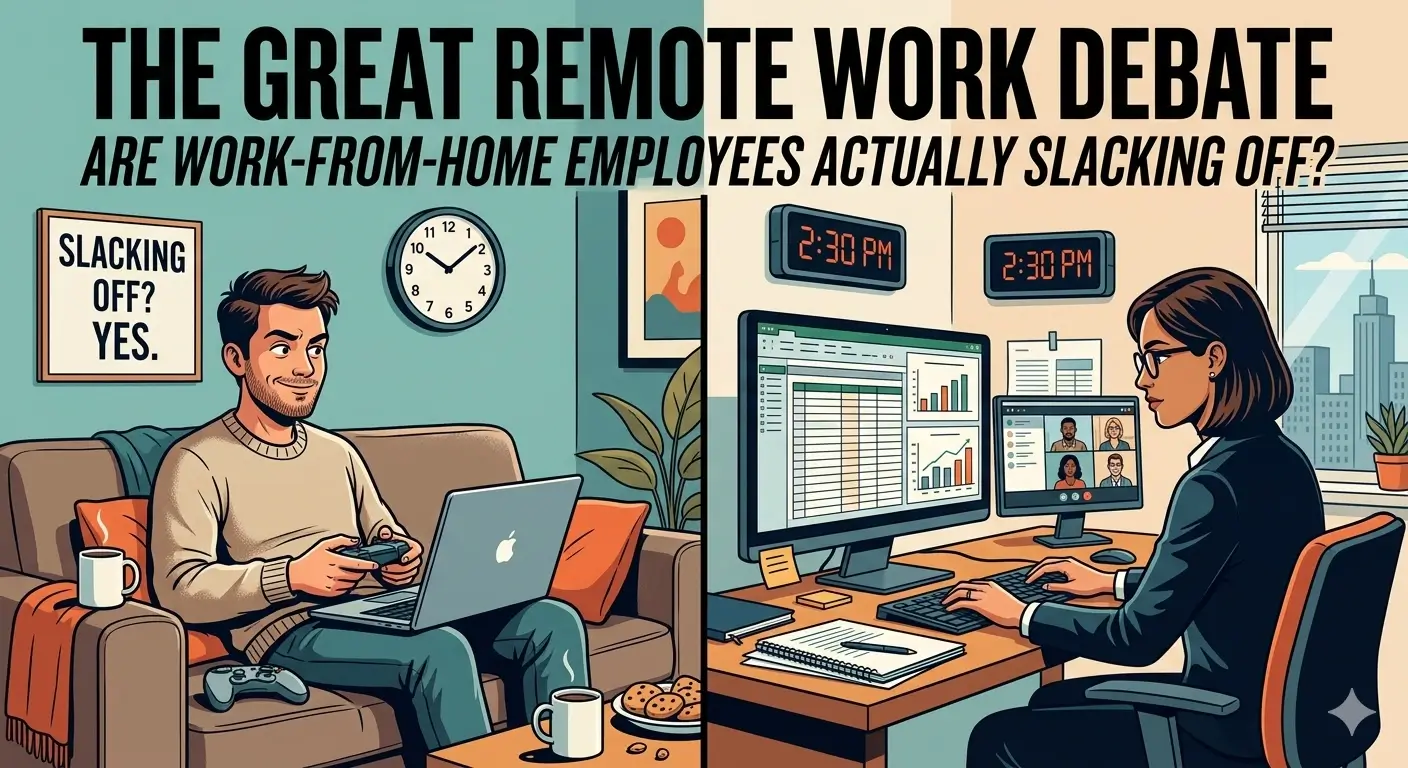
The Great Remote Work Debate: Are Work-From-Home Employees Actually Slacking Off?
Corporate Culture Desk
Deep Dive Analysis • 8 min read
A Tale of Two Timelines
Meet Rohan. It is exactly 2:15 PM, and he is currently in his kitchen in Bengaluru, waiting for his pressure cooker to whistle. To a traditional, old-school corporate executive pacing an office floor, Rohan is the ultimate proof that the remote work model fails—he is caught running personal chores on company time.
But let’s look at the actual math of Rohan’s day. By working from home, he bypassed a grueling, soul-crushing 90-minute morning battle through Silk Board traffic. Instead of sitting frustrated in a cab, he fired up his laptop at 8:00 AM, cleanly answering regional client emails before the official workday even started. His 10-minute break to check on lunch replaces the 45 minutes of idle, non-productive water-cooler gossip that routinely happens in physical offices.
Tonight, because he doesn’t have to face a dark, exhausting commute back home, he will log back on around 8:00 PM to smoothly coordinate a deployment with the US team. Is Rohan truly slacking off, or has he simply optimized his life to perform better?
The global corporate world is locked in a massive, high-stakes identity crisis. On one side of the ring, we see an aggressive, uncompromising return-to-office (RTO) push driven by senior executives who are firmly convinced that empty office chairs directly equal empty minds. On the other side, millions of knowledge workers are fiercely defending their flexibility, asserting that they have never been more focused or efficient.
But if we step back from the loud, anecdotal corporate complaints, what does the empirical data actually tell us? Are work-from-home (WFH) employees genuinely moving the needle for their companies, or has remote flexibility turned into a convenient shield for digital laziness? Let’s analyze the real numbers, the psychological warfare behind employee tracking, and the shifting dynamics of the modern workforce.
1. The Hard Data: What Large-Scale Studies Actually Reveal
When you analyze broad, aggregated data pools rather than isolated corporate complaints, the narrative of the lazy, checked-out remote worker completely disintegrates. Rigorous workplace studies demonstrate that remote and hybrid frameworks regularly maintain or significantly supercharge professional output.
A comprehensive, massive meta-analysis evaluating the performance patterns of over 800,000 corporate employees confirmed that overall operational productivity either remained perfectly stable or saw a distinct upward spike when individuals transitioned to home environments. The widespread assumption that physical proximity to a manager is the only way to guarantee focus is thoroughly debunked by modern metrics.
Research shows that eliminating the daily commute gives workers an average of 72 minutes back per day. Crucially, employees don’t just sleep in—they directly redirect roughly 40% of that reclaimed time right back into performing actual, core job tasks.
By completely escaping the random drop-ins, loud conversations, and constant micro-interruptions inherent to open-office floor plans, remote professionals gain an average of 62 highly focused, uninterrupted work hours every single year.
According to long-term workplace indicators updated by Gallup, roughly 52% of remote-capable professionals operate in structured hybrid setups, while 26% work completely remotely. The data clearly shows that these individuals aren’t hiding from responsibilities. Instead, they report substantially higher rates of “thriving” in their personal well-being and professional engagement compared to their fully on-site counterparts who face forced five-day office mandates.
2. Understanding “Productivity Paranoia”
If the data is so overwhelmingly positive, why are corporate leaders around the world panicking and issuing strict ultimatums? It boils down to a profound psychological phenomenon known as Productivity Paranoia. This is a deep-seated management anxiety where leaders cannot separate physical presence from actual contribution. Put simply: if a manager cannot see you sitting at a desk, they instinctively assume you are slacking off.
This deep lack of foundational trust has fueled a massive, controversial boom in the employee surveillance industry. To ease their anxieties, a staggering 60% of major companies with distributed workforces now deploy dedicated digital tracking tools. Organizations are using advanced software solutions, like those provided by Insightful, to closely monitor employee desktops, track active versus idle windows, record keystrokes, and even take automated, periodic screenshots of worker screens throughout the day.
The Toxic Backfire of Micro-Surveillance
Treating highly skilled adults like untrustworthy children yields incredibly toxic results. Extensive industry tracking highlights that aggressive tracking software severely spikes employee stress, accelerates burnout, and utterly destroys company morale. Instead of fostering real performance, it forces employees to master the art of “digital theater.” Workers spend their mental energy purchasing physical hardware mouse jigglers, keeping Slack status lights green, and artificially inflating their activity scores rather than engaging in deep, high-value problem solving.
3. The Shifting Paradigm: From Desktop Activity to Clear Outcomes
The fundamental truth that corporate traditionalists must face is that the physical office environment was never a flawless temple of uninterrupted focus. Long lunches, extended coffee breaks, casual hallway chats, and theatrical “looking busy” at a desk historically drained enormous blocks of the standard eight-hour workday.
As outlined in extensive workforce metrics published by Toggl Track, the most successful and profitable distributed teams are entirely abandoning old-school attendance metrics. They are replacing them with objective, output-based key performance indicators (KPIs).
When leadership transitions to an asynchronous, outcome-focused model, the paranoia vanishes. If a senior developer cleanly delivers her software modules ahead of a sprint deadline, or if a designer pushes a brilliant product template, it becomes entirely irrelevant whether they took an hour off in the middle of the afternoon to walk their dog, meditate, or rest. Performance is judged by the value created, not by hours spent trapped inside a cubicle grid.
The Verdict: Trust is the Ultimate Currency
Are there individual remote workers who actively slack off and abuse the system? Absolutely. But unmotivated, underperforming workers have always existed. In the traditional office, they simply perfected the art of walking around holding a folder, staring intensely at a random spreadsheet, and looking incredibly busy whenever a senior manager walked past their desk.
The remote and hybrid work revolution did not invent slacking; it simply unmasked how outdated, superficial, and broken our corporate metrics for evaluating human contribution truly were. The future of global business does not belong to companies that police bathroom breaks and monitor mouse clicks. It belongs to highly agile, high-trust organizations that grant their teams autonomy, judge them strictly on clear outcomes, and understand that flexibility is the single greatest tool for retaining world-class talent.