
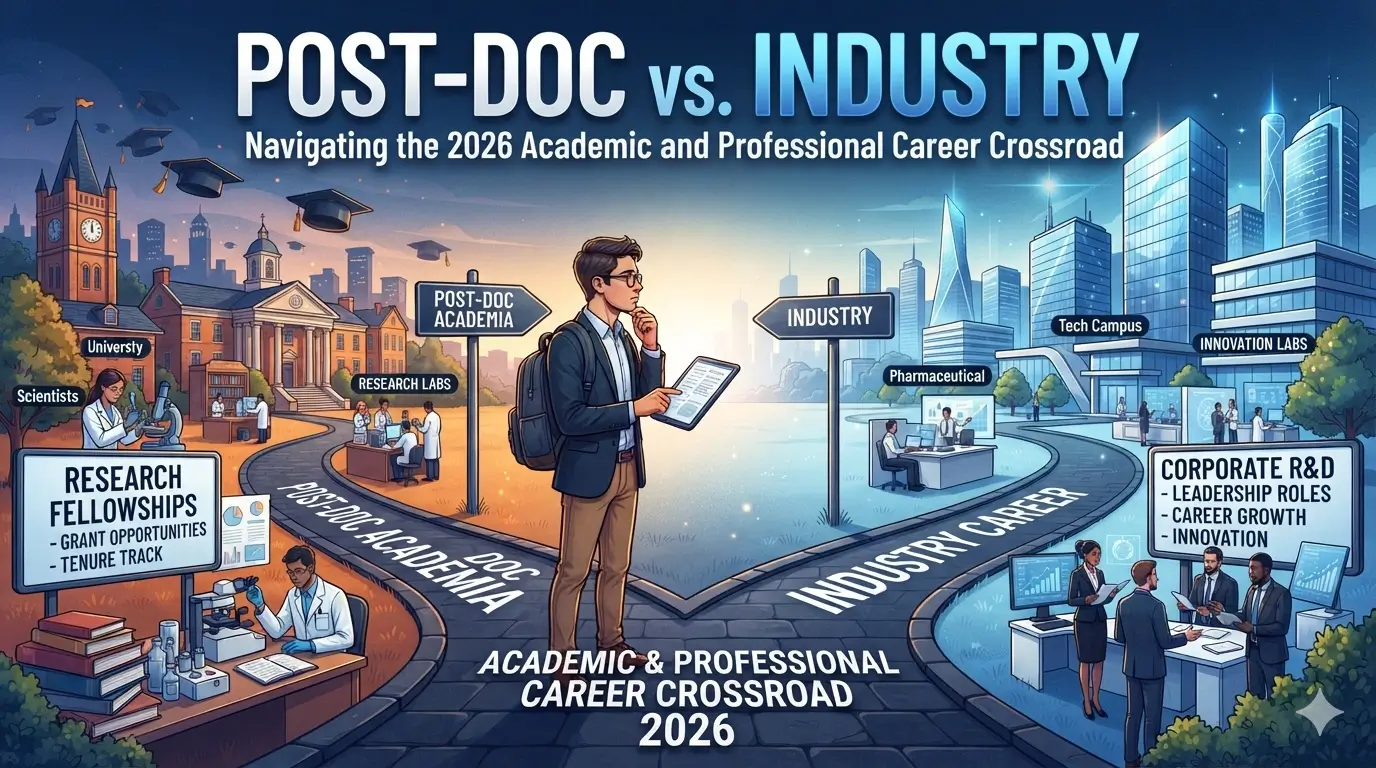
Post-Doc vs. Industry: Navigating the 2026 Academic and Professional Career Crossroad
For decades, completing a doctoral degree followed a fairly predictable trajectory: defend the dissertation, secure a postdoctoral research fellowship, publish extensively, and eventually climb the tenure-track ladder toward a professorship. However, the higher education and corporate landscapes of 2026 look radically different. Rapid shifts in global economies, the widespread integration of advanced artificial intelligence into corporate R&D, and changing financial realities within universities have turned this linear path into a complex maze.
Today, fresh PhD graduates and current post-docs find themselves standing at a pivotal career crossroad. Should they commit to the traditional academic marathon of securing a post-doc and chasing tenure, or should they pivot to industrial research and development where compensation, resources, and agile project pacing offer a starkly different lifestyle? Let us examine the data, realities, and strategic considerations defining the 2026 career choice between post-doc positions and industry roles.
1. The Post-Doc Landscape in 2026: Prestige, Purpose, and Precariousness
The postdoctoral fellowship has historically served as an apprenticeship—a necessary bridge between being a student and becoming an independent principal investigator (PI). In 2026, post-docs remain vital for high-level scientific breakthroughs, particularly in heavily funded fields like biotechnology, quantum computing, and advanced materials science.
However, structural bottlenecks persist:
- Financial Strain: Despite localized policy adjustments, post-doctoral stipends frequently lag behind market inflation rates, creating significant financial anxiety for researchers in their late twenties and thirties.
- The Tenure Bottleneck: The ratio of open tenure-track faculty positions to the high volume of graduating PhDs remains severely skewed, meaning many researchers cycle through multiple post-doc positions without guaranteeing a permanent academic home.
- Deep Intellectual Freedom: On the flip side, the primary draw of a post-doc remains the unmatched autonomy to pursue fundamental, curiosity-driven science without immediate commercial pressures.
2. The Corporate R&D Shift: Why Industry is Luring Top Minds
Simultaneously, global corporations have aggressively scaled up their internal research arms. Tech giants, pharmaceutical leaders, energy conglomerates, and private research institutes now recognize that theoretical depth paired with practical application yields disruptive market advantages.
Industry research roles in 2026 offer several compelling advantages:
- Resource Abundance: While academic labs often struggle with grant writing cycles and equipment budgets, industry teams operate with robust infrastructure and massive computational or experimental resources.
- Collaborative Impact: Corporate projects frequently move from concept to deployment at a velocity that is rare in university settings, allowing researchers to see their discoveries impact real-world products rapidly.
- Market-Aligned Compensation: Competitive starting salaries, stock options, and comprehensive benefits packages provide immediate financial stability and long-term security.
Key Takeaway: The traditional stigma that moving to industry equates to “selling out” has completely dissolved. In 2026, corporate labs are often where the most cutting-edge, cross-disciplinary science actually happens.
3. Skill Mapping: What Sets You Apart in Each Ecosystem?
Choosing between these two paths requires an honest evaluation of your personal strengths, workflow preferences, and long-term professional identity. Each ecosystem demands a distinct psychological and technical profile.
If you choose to pursue an advanced post-doc and target academia, you must master grant acquisition, long-term project management, peer-review management, and student mentorship. Your currency is your citation count, h-index, and publication record in high-impact, Scopus-indexed journals. Success here requires immense patience and intrinsic motivation, as external validation can take years to materialize.
Conversely, if you target corporate research or industrial engineering, your technical competence must be matched by cross-functional agility. Industry values rapid prototyping, teamwork within agile frameworks, intellectual property (patents over pure papers), and the ability to translate complex data insights into language that non-technical stakeholders can understand. Communication and adaptability are your greatest assets in the corporate sector.
4. Practical Decision-Making: A Comparative Framework
To help structure your choice, consider the following side-by-side comparison of day-to-day realities in both domains:
🏛️ The Post-Doc / Academic Track
Daily Focus: Writing grants, teaching undergraduate cohorts, running experiments, and managing lab publications.
Pacing: Slow, methodical, and governed by academic calendar cycles and peer-review wait times.
Pros: Maximum intellectual freedom and publication ownership.
Cons: High job insecurity, lower pay, and intense administrative burdens.
🏢 The Industry R&D Track
Daily Focus: Product development, cross-team alignment, rapid prototyping, and proprietary data analysis.
Pacing: Fast, milestone-driven, and tied to quarterly business objectives.
Pros: High financial compensation, modern tools, and visible societal impact.
Cons: Restricted publishing rights due to confidentiality and corporate shifting priorities.
5. The Hybrid Alternative: Blended Careers in 2026
It is worth noting that the binary choice between a permanent academic post and a corporate ladder is no longer absolute. Modern researchers are increasingly carving out hybrid careers. Many PhDs complete a short, targeted post-doc or industry fellowship to build specialized technical depth before transitioning into government laboratories, science policy advising, tech-transfer offices, or entrepreneurial startup ventures.
Furthermore, adjunct professorships and university-industry joint research initiatives allow corporate scientists to maintain a foot in academia, guiding graduate students while drawing a corporate salary. Flexibility is the ultimate hallmark of the modern 2026 workforce.
Conclusion
Navigating the post-doc versus industry crossroad is not about finding the universally “right” path; it is about aligning your career vehicle with your personal definition of success. Whether you choose the deep intellectual exploration of an academic post-doc or the fast-paced, well-resourced ecosystem of corporate research, approach the decision with strategic clarity. Evaluate your skills, weigh the compromises, and step confidently into the future of your profession.