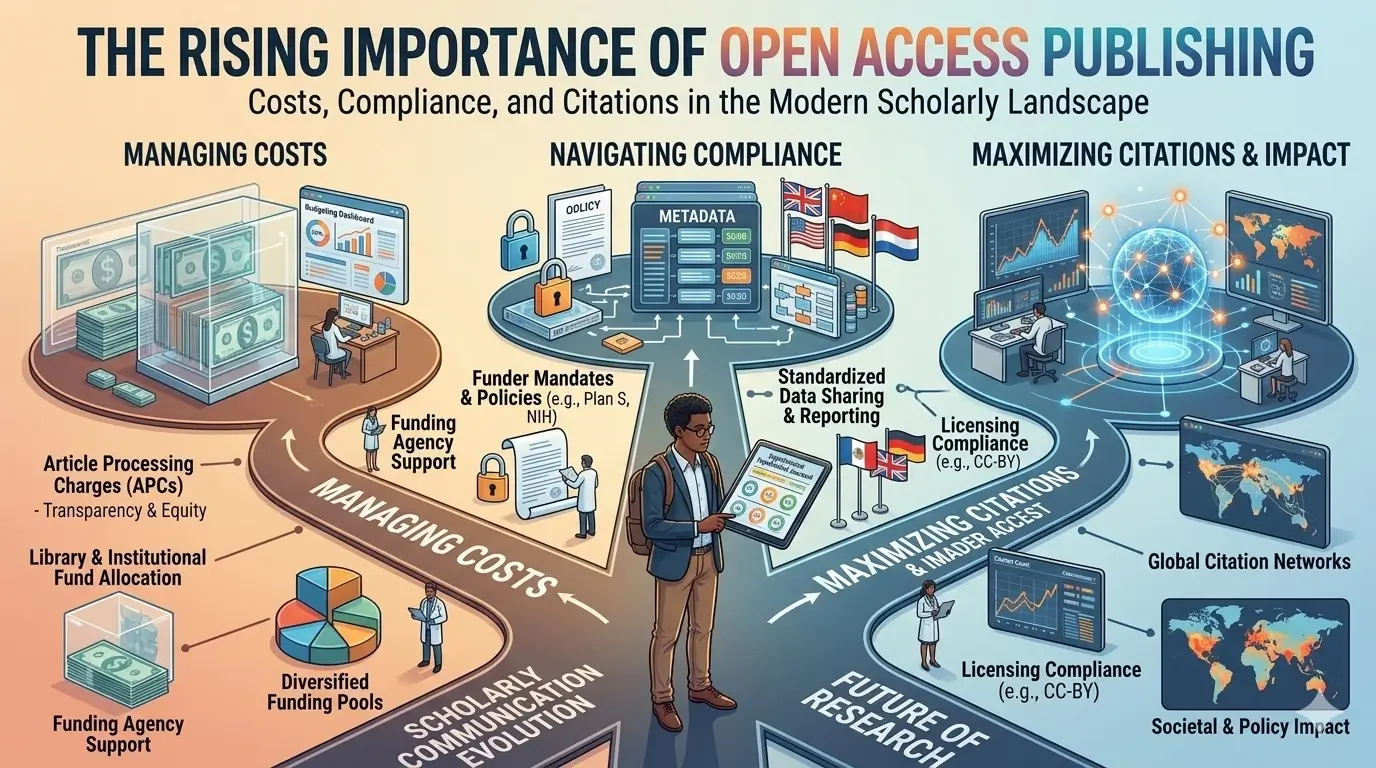
The Rising Importance of Open Access Publishing: Costs, Compliance, and Citations
Over the past decade, the global academic publishing landscape has undergone a monumental shift. What was once a niche movement championed by open-science advocates has now become the dominant paradigm. Globally, over half of all newly published peer-reviewed research papers are now open access in some form. Driven by institutional transformations, society-wide policy shifts—such as major computing and scientific societies moving entirely to open access models—and an aggressive push from funding agencies, researchers can no longer treat open access as an afterthought.
However, navigating this modern publishing ecosystem requires far more than simply checking a box on a submission portal. For contemporary researchers, post-docs, and principal investigators, choosing an open access route involves balancing rising financial constraints, complex funder mandates, and the undeniable advantage of boosted citation metrics. Let us dissect the core components of open access publishing and how you can optimize your next manuscript for maximum visibility and compliance.
1. The Evolving Open Access Landscape: From Gold to Diamond
Open access (OA) publishing eliminates subscription barriers, allowing anyone worldwide to read, download, and build upon research outputs instantly. Yet, “open access” is not a monolith; it operates through several distinct operational models:
- Gold Open Access: The final published version of record is immediately free on the publisher’s platform, typically financed by an Article Processing Charge (APC) paid by the author, their institution, or a grant.
- Green Open Access (Self-Archiving): Researchers publish in a subscription journal but deposit their peer-reviewed Accepted Manuscript into an institutional or subject-matter repository (like arXiv or PubMed Central), often adhering to specific embargo rules.
- Diamond Open Access: Neither readers nor authors pay fees. These community-driven, society-backed journals or platforms are funded by academic institutions, consortia, or grants, offering a sustainable alternative to commercial publishing inflation.
- Hybrid Open Access: Traditional subscription journals offer individual authors the option to make their specific paper open access by paying an APC while keeping the rest of the journal behind a paywall.
2. The Cost Dilemma: Article Processing Charges (APCs) and Financial Realities
While the democratization of knowledge is a noble goal, the financial mechanisms sustaining open access have created fierce debate across the global research community. Article Processing Charges continue to trend upward across both fully open access portfolios and hybrid journals, with elite prestige journals occasionally demanding over $10,000 per paper.
This dynamic introduces significant systemic challenges:
- Budget Cannibalization: Heavy APC spending drains institutional or project budgets that could otherwise fund laboratory materials, equipment maintenance, graduate stipends, or conference travel.
- Inequity for Unfunded Scholars: Researchers from developing nations or independent institutions without transformative institutional agreements often find themselves locked out of high-impact open access venues.
- Emerging Cost Caps: Major national funding agencies have proposed or implemented strict caps on grant-funded APCs, forcing researchers to seek lower-cost avenues or rely more heavily on Green OA repository routes.
Pro Tip: Before writing your budget or submitting your paper, verify whether your university library maintains a “Read & Publish” or transformative agreement with the publisher. Many institutions cover or discount APCs automatically for corresponding authors.
3. Funder Compliance: Why Checking the Rules Early Matters
In previous years, researchers could often resolve open access compliance issues months after a paper was accepted. In the current policy climate, waiting until acceptance can jeopardize your grant eligibility. Major global funding frameworks—including the National Institutes of Health (NIH), UK Research and Innovation (UKRI), and Horizon Europe—enforce rigorous compliance standards.
To remain compliant, researchers must carefully review three variables before hitting submit:
- The Timeline Mandate: Many modern policies demand immediate open access upon publication, meaning embargoed repository pathways no longer satisfy the requirement.
- Licensing Expectations: Funding bodies frequently mandate specific licensing agreements, such as the Creative Commons Attribution (CC BY) license, allowing maximum re-use and text mining.
- Repository Validation: If utilizing Green OA, ensure your chosen institutional repository is recognized as a “trusted repository” under your funder’s exact guidelines.
4. The Citation Advantage: Does Open Access Really Boost Impact?
One of the strongest incentives for choosing open access publishing is the well-documented “open access citation advantage.” Because paywalls restrict access to university libraries and wealthy institutions, paywalled papers are inherently invisible to independent practitioners, researchers in the global South, and scholars at smaller regional colleges.
When you remove these barriers:
- Broader Readability: Your work is discovered, read, and cited by a vastly wider cross-section of the international academic community.
- Faster Velocity: Open access articles often accumulate citations much faster in the months immediately following publication compared to subscription-locked counterparts.
- Enhanced Altmetrics: Beyond traditional academic citations, open access papers are more frequently cited in policy documents, media outlets, and educational blogs, driving broader societal impact.
5. Practical Evaluation: Navigating Quality and Avoiding Predatory Journals
The explosive growth of open access has unfortunately given rise to predatory publishers who exploit author-pay models without offering legitimate peer review, editorial oversight, or proper database indexing.
Protecting your academic reputation requires strict due diligence:
❌ Predatory / Low-Quality OA Warning Signs
Practices: Aggressive email spamming promising 3-day turnaround times; opaque or hidden APC pricing structures; fake or ghost editorial boards; lack of proper indexing in Scopus, Web of Science, or DOAJ.
Risk: Damages career credibility and wastes valuable grant funds.
✔️ Legitimate Open Access Verification
Practices: Transparent peer-review guidelines; clear, upfront fee schedules with waiver policies; verifiable indexing in directories like DOAJ (Directory of Open Access Journals); recognized academic editorial board.
Benefit: Ensures compliance, prestige, and rigorous validation.
Conclusion
Open access publishing is no longer an optional preference; it is the structural backbone of modern academic communication. By thoughtfully evaluating publishing costs, ensuring strict alignment with funder compliance guidelines, and choosing reputable, indexed venues, you protect your research budget while maximizing your global citation impact. Approach your next publication strategy with eyes wide open, and let your research reach the widest possible audience.