
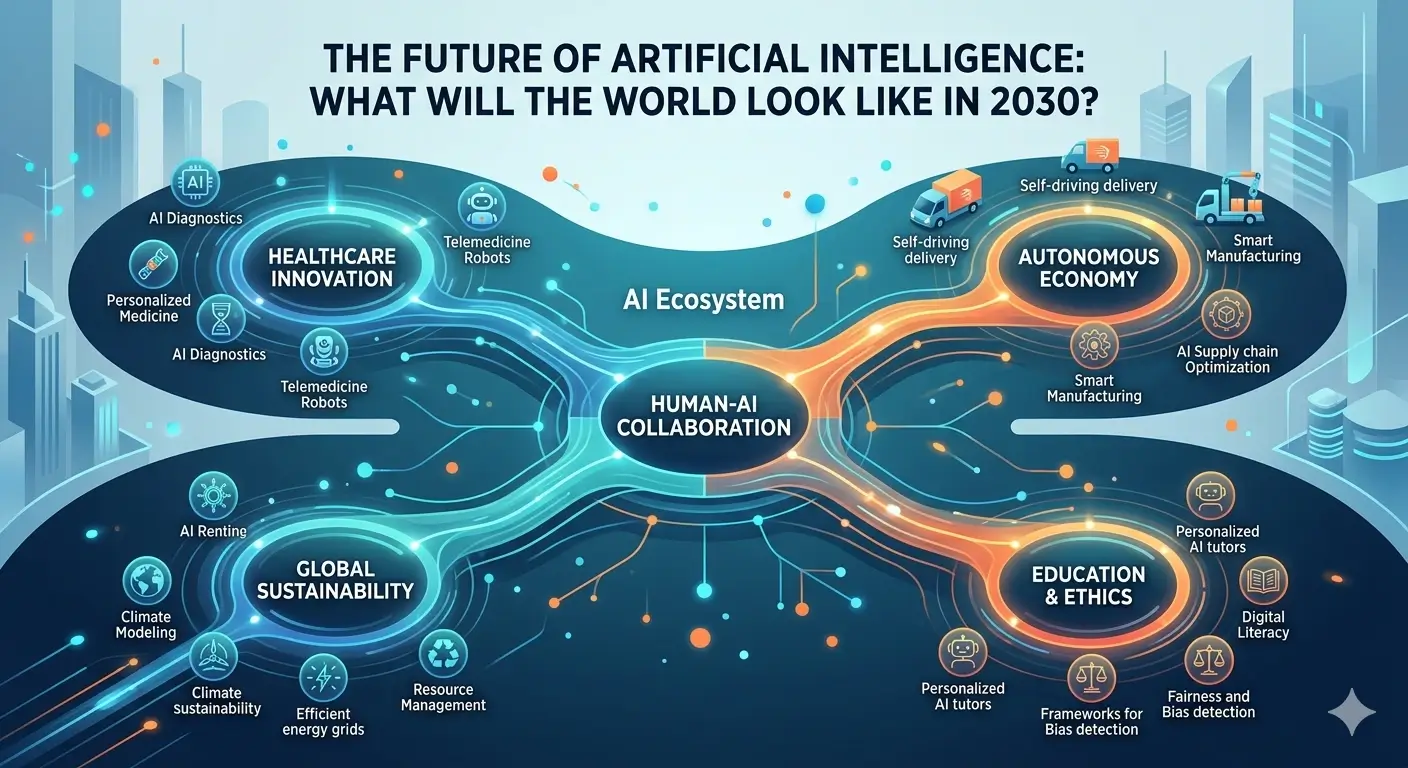
The Future of Artificial Intelligence: What Will the World Look Like in 2030?
Editorial Team
Published Section • 6 min read
“Let’s paint a picture of a random Tuesday morning in 2030. You do not wake up to a blaring, stressful alarm. Instead, your room gently brightens, mimicking a natural sunrise that aligns with your body’s circadian rhythm…”
Your smart hub has already brewed a coffee calibrated with the exact nutrient balance your body needs today based entirely on your overnight health vitals. Before you even check your phone, your personal AI assistant gives you a friendly audio summary of your day, prioritizing tasks that actually matter to you.
It sounds like a sequence pulled straight out of a premium sci-fi movie. But it is not. This is the tangible, rapidly approaching reality of our near future.
Artificial Intelligence has shattered its old reputation of being a niche tech plaything. It is fast evolving into the invisible infrastructure of our entire world. By 2030, AI will weave itself into the background of healthcare, global economies, education, and our daily human routines. Let’s strip away the corporate marketing hype and look at what authentic research tells us about how our lives will truly shift over the next few years.
1. Moving Past Chatbots: The Road to AGI
Right now, we are playing around with “Narrow AI.” These systems are clever at singular tasks like generating images or debugging code, but they lack human context. By 2030, the tech landscape will look vastly different as we edge closer to Artificial General Intelligence (AGI).
The Evolution of Intelligence
Single-task mastery (image generation, code assistance, data sorting).
Systems that independently plan and execute multi-step projects without constant human hand-holding.
Software that can think, reason, adapt, and apply knowledge across completely diverse fields at a human level.
Tech pioneers like OpenAI are aggressively pouring resources into solving this puzzle, shifting us from passive assistants to collaborative partners.
2. Healthcare: A Shield Instead of a Band-Aid
If there is one space where AI will feel like an absolute blessing, it is medicine. Our modern medical system is fundamentally reactive—we wait until we feel sick, and then we seek a cure. AI will turn that entire approach on its head.
Imagine continuous, non-invasive health monitoring via smart clothing and bio-sensors. These systems will cross-reference your data in real-time, flagging markers for conditions like cardiovascular strain or early cancers years before a physical symptom ever shows up. The World Health Organization (WHO) highlights that digital health integration will be absolute game-changers in lowering global mortality rates.
3. The Workforce: Becoming a Director, Not a Workhorse
“AI will not replace humans, but professionals who master AI will inevitably replace those who do not.”
By 2030, your day-to-day job will look less like manual execution and more like creative direction with a built-in AI copilot. Consider how roles transform:
Use AI to generate data-backed rough drafts, focusing human energy entirely on emotional depth and messaging strategy.
Act as system architects and logic validators while AI models effortlessly generate up to 90% of baseline code.
Leave sorting through thousands of pages of grueling case law to algorithms, saving energy for high-level courtroom strategy.
We will also see advanced robotics step up to handle genuinely hazardous, repetitive labor. Extensive workforce research by the McKinsey Global Institute reminds us that this shift requires an urgent global commitment to upskilling workers.
4. Learning Without Borders: The Personal AI Tutor
The current education framework is a relic of the industrial age. By 2030, AI will completely democratize learning. Imagine an incredibly patient personal tutor available to every single child with an internet connection.
If a young student is a visual learner who loves video games, the AI tutor will adapt on the fly, spinning up an interactive virtual world to explain algebraic equations seamlessly. Education shifts from mass factory processing to tailored personal mentorship.
5. Healing the Planet and Managing Smart Cities
In our cities, traffic grids will become living, self-optimizing networks. Real-time AI routing will eliminate gridlock entirely, adjusting traffic signals dynamically based on real-world flow. When it comes to the climate crisis, AI is a crucial weapon. It will manage renewable energy storage, predicting precisely when solar grids or wind farms need to hold or distribute power.
According to data frameworks explored by the World Economic Forum, smart infrastructure driven by machine learning is one of our most viable lifelines to hit real net-zero goals.
⚠️ 6. Keeping It Real: The Ethical Risks We Must Face
As generative voice cloning and deepfake video capabilities become completely indistinguishable from real life, our relationship with digital truth will be tested. Without heavy encryption and digital watermarking systems, bad actors can easily weaponize hyper-realistic misinformation to sway democratic elections or manipulate stock markets.
Furthermore, training bleeding-edge AI models takes massive capital. If we are not careful, the keys to AGI will belong to a tiny handful of multi-trillion-dollar corporations. Thought leaders at major research entities like Gartner constantly warn that setting up ironclad global AI governance and ethical guardrails is a matter of immediate necessity.
The Path Forward: Up to Us
The leap into 2030 will feel like an exponential roller coaster ride. Technology is altering the fundamental playbook of society far quicker than our laws can easily accommodate. The future will not belong to the smartest machine, but to the humans who learn how to dance with them.
The most valuable skills of the next decade won’t be rote memorization, but radical adaptability, deep critical thinking, and raw human empathy—traits that silicon and code can never truly mimic.